Gas explosion at Ralph Fallon's house
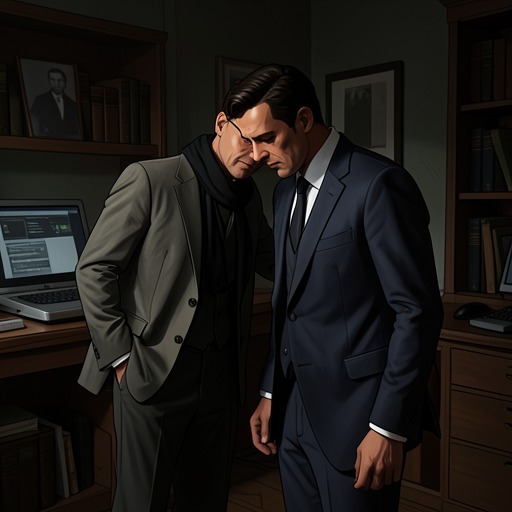
The AxThe gas explosion at Ralph Fallon’s house is the final stage of Burke Devore’s attempt to disguise Fallon’s murder as an accident. Burke leaves Fallon’s body in a house rigged for a blast, then waits on the road until the light and sound confirm that the explosion has occurred. The scene turns a deliberate killing into a planned piece of apparent misfortune, while showing how carefully Burke manages the evidence and his distance from its consequences.
Discovery and Preparation
Before setting the explosion in motion, Burke hears Fallon making terrible noises. Once he has found a candle and has nothing else to distract him, the sounds become unbearable, and he leaves the room carrying his windbreaker. He puts it on as he walks through the house. Gloves and an iron pipe are in its other pocket; he will not use the pipe, but intends to take it away. Wearing the gloves, he starts at the front door and wipes the surfaces he can remember touching, turning off the lights as he goes but leaving the bedside lamp on in Fallon’s bedroom.
When Burke returns, Fallon is quiet and slumped over. Burke removes the tape from Fallon’s ankles and torso; Fallon’s head strikes the table as he falls forward. Lifting it, Burke sees that Fallon has vomited into his mouth, and that the vomit has gone into his nose and lungs because the tape prevented it from coming out. Burke concludes that Fallon drowned rather than suffocated. The discovery specifies the physical cause of death, but does not alter Burke’s plan to make the death appear accidental. He gathers the pieces of duct tape in one of Fallon’s small plastic trash bags and puts it in his windbreaker pocket, then lights the candle with one of Fallon’s wooden kitchen matches.
The Planned Explosion
Burke uses the house’s kitchen and the propane stored outside as the means of producing the blast. He notes that gas stoves in New York State use electric igniters rather than pilot lights. He turns the front two burners to high, blows out their flames, and leaves the kitchen, closing its inner door so that the room has no openings. The detail about the igniters explains how he can leave gas flowing without keeping a stove flame alight; the closed door confines the kitchen as he prepares to leave.
Burke exits through a door that Fallon had not known was unlocked. Moving past the front of the house, he sees the candle’s low, flickering light and four tall, narrow metal propane bottles tucked against the outside wall, beside the end of the enclosed porch. He continues down the driveway and road to the Voyager. His actions have two linked purposes: to create the explosion and to leave the house without remaining there when it happens. The gloves, the recovered tape, the wiped surfaces, and the lights switched off are part of the same effort to control what can be traced back to him.
The Intended Cover Story
Burke does not know how long the explosion will take. He wants to be far enough away not to be caught in it, but close enough to know that it has happened. He assumes the stove will explode and set off the propane bottles as well. In his calculation, little of Fallon or the kitchen should remain, but enough should survive to make the supposed cause intelligible: a drunk man fell asleep without realizing what he had done to the stove. Burke further assumes that people who knew Fallon would find such carelessness unsurprising. This anticipated account depends not only on the blast but on Fallon’s reputation as Burke imagines it, turning the victim’s supposed habits into cover for a murder.
Burke drives slowly past the house and continues several miles toward the intersection where he would turn right for Arcadia. He stops, checks the rearview mirror, and makes a U-turn in the empty intersection. On the way back, about half a mile from the intersection, he sees a sudden yellow light ahead, silhouetting woods and houses. The light fades, then flares brighter with red and white mixed into the yellow, before dimming again. A double blast rolls over the car with force Burke likens to a wave. The change from a controlled wait to a flash and physical shock marks the point at which his intended spectacle becomes an event he can observe but cannot control.
Aftermath and Significance
Burke stops, makes another U-turn, and drives home. The account confirms that he witnesses the explosion’s light and hears its blast, but it does not establish the extent of the damage or whether the scene ultimately convinces investigators of his cover story. His certainty about what should remain is part of his plan, not a report of the aftermath. The explosion therefore closes the immediate operation without resolving its success.
The episode’s sequence—body, evidence, staged accident, retreat, distant confirmation—makes the explosion more than a destructive act: it is Burke’s attempt to impose a false explanation on a death he has already caused. Its blunt mechanics contrast with the moral reasoning that follows in the narration, which identifies the end justifies the means as a modern code of ethics. The blast gives that logic a concrete form: Burke treats Fallon’s death, the physical destruction, and the concealment of responsibility as acceptable instruments toward his own objective.